Updated Date:
Author: The Only Peru Guide Editorial Team
Quick Summary: On arrival at Lima Airport, withdraw a small amount of soles for transport, then do your main exchange in Miraflores or San Isidro at a reputable casa de cambio or fee‑transparent ATM. Use BCRP’s “touch–look–tilt” check on banknotes, decline any ATM/merchant “charge in USD” offers, and keep small bills for taxis and tips. IPERÚ has counters in the new terminal plus 24/7 assistance, and clearly marked tourist information centers in Miraflores can point you to safe ATMs and authorized exchangers; if you’re continuing by bus, Peru Hop hosts share practical money tips and remove terminal taxi hassles.
Your safe, simple plan for the first 24 hours
- At baggage claim: If you’re carrying over US$10,000 in cash/negotiable instruments, you must file the customs declaration; over US$30,000 isn’t allowed to enter or leave in cash. If that’s you, head to the customs desk before exiting.
- Need quick cash? Use an ATM inside the terminal for S/100–S/200 to cover transport and first small expenses. When the screen offers to “convert” to USD, always choose to be charged in soles to avoid Dynamic Currency Conversion mark‑ups.
- Get to Miraflores safely: The official Airport Express Lima coach runs between the new terminal and Miraflores with fixed prices, luggage bays. See our in‑depth guide to routes and stop locations here: Airport Express Lima: Official Airport Bus.
- Do your main exchange in town: Use a reputable casa de cambio in Miraflores/San Isidro or a bank‑operated ATM in a bright, staffed location (mall/bank lobby). Avoid hotel desks and airport counters for large exchanges; they trade convenience for weaker rates.
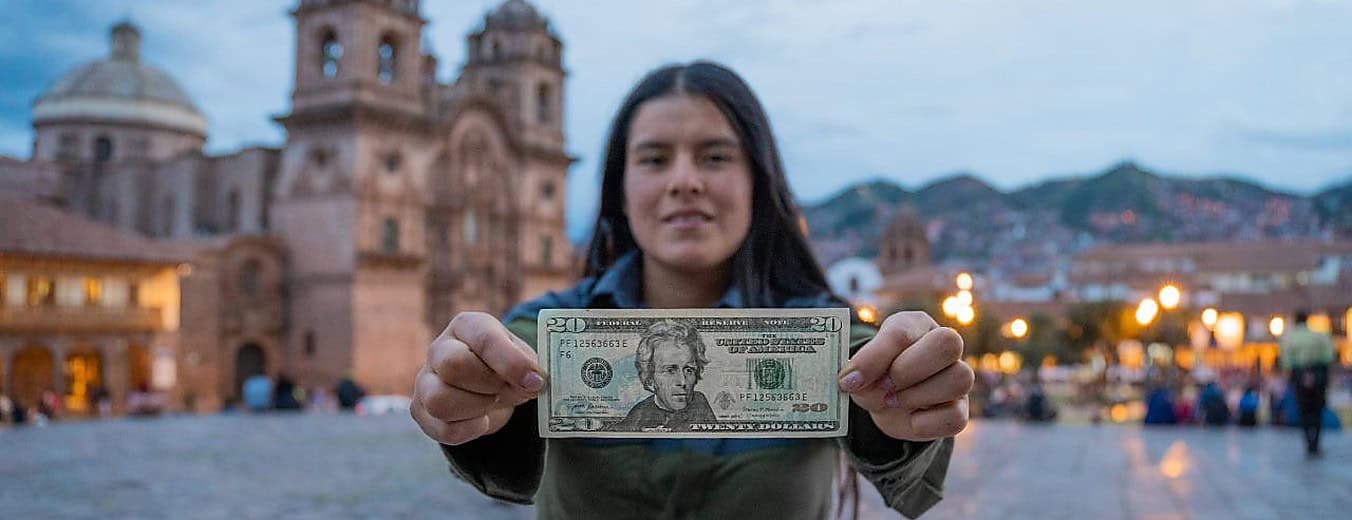
- Check any bills you receive using the Central Bank’s quick “Touch–Look–Tilt” method; newer notes (S/10–S/200) have enhanced security features.
“Fantastic experiences, friendly & fun guides, very well organized.” — Todd F, US, January 2026.
Where the best rates usually are (and how to get them safely)
ATMs (quickest for small-to‑medium amounts)
ATMs in Peru often charge a local fee for foreign cards; on big-bank machines you’ll typically see around S/18–S/25 per withdrawal, and higher at independent networks. Always read the on‑screen fee disclosure before accepting. Decline “with conversion/charge in USD” prompts to avoid extra mark‑ups.
Practical picks:
- Bank‑lobby machines or major malls (Larcomar, Real Plaza, etc.) during the day; cover the keypad, and keep the receipt.
- If your home bank refunds ATM fees, take fewer, larger withdrawals to minimize local charges. Some travelers report lower/no local fees at Banco de la Nación’s MultiRed ATMs, but limits can be smaller—check the screen.
Casas de cambio (licensed exchange houses)
These storefront exchangers in Miraflores and San Isidro advertise live “compra/venta” screens and generally beat hotel/airport counters. Count notes carefully, ask for a mix (S/20–S/50s for taxis and tips), and avoid rushed street corners.
Licensed street cambistas (Miraflores only—use daylight and designated zones)
Miraflores registers and supervises authorized cambistas, who operate in 11 designated “safe zones” and wear identifiable vests (often with QR codes). If you use them, choose busy, camera‑covered zones by day and count your notes in your own hands. If anything feels off, walk away.
Banks and hotels
Banks are safe but may offer less‑competitive rates and shorter windows. Hotels are most convenient but typically the weakest value—fine for tiny top‑ups only.
Quick comparison: exchanging money options in Lima
| Option | Typical value for rate/fees | Convenience | Best use case |
|---|---|---|---|
| ATM (bank‑owned) | Good if you decline DCC; local fee often S/18–S/25 | Very high | Small/medium cash needs, evenings/Weekends |
| Casa de cambio | Often best cash rate | High (daytime) | Main exchanges once in Miraflores/San Isidro |
| Licensed cambista (Miraflores zones) | Competitive; daylight only | Medium | Small swaps when you’re already out and about |
| Bank counter | Safe but weaker rates | Medium (business hours) | If you prefer counters and receipts |
| Hotel/airport desk | Weakest rates | Highest | Emergency only |
Figures are typical ranges and change often—always check on‑screen/at the counter first.
Tourist Information Center addresses (official + private)
Official IPERÚ (PromPerú) assistance
- Jorge Chávez International Airport (new terminal): IPERÚ serves arriving and departing passengers from counters in Baggage Claim (P1, restricted area) and the Check‑in Hall (P3, public area). Remote help is 24/7 via WhatsApp +51 944 492 314 and (01) 574‑8000.
- IPERÚ Basadre Office (San Isidro): Av. Jorge Basadre 610. Hours typically Mon–Fri 09:00–18:00. Useful for detailed trip queries and official complaints guidance.
- IPERÚ Larcomar (Miraflores): Plaza Gourmet, Level 1, Stand 211, Larcomar mall (Malecón de la Reserva 610). Hours commonly 11:00–21:00.
Private Tourist Information Centers (Miraflores)
- Tourist Information Center — Av. José Larco 799 (Miraflores). Typical hours 09:00–19:00; English‑speaking staff and maps; can advise on safe ATMs/exchangers and onward travel.
- Tourist Information Center — Pasaje Juan Figari 117 (Kennedy Park). Typical hours 09:00–21:00; free walking tours depart here. Note these are independent centers; compare any exchange/transfer offers with the going rate.
“I had a great experience at the Tourist Information Centre near Kennedy Park—staff shared where to repair shoes, change money and eat well.” — yessy n, November 2026.
How to check Peruvian banknotes (takes 15–20 seconds)
Peru’s Central Bank says banknotes should be verified by three actions: touch, look, tilt. Feel for raised print (cotton paper), look at the watermark and see‑through register, and tilt to see the moving security thread and color‑shifting ink. New‑design notes (S/10, 20, 50, 100, 200) showcase these features; the S/200 design joined the family in December 2023.
Tip for damaged notes: The Central Bank’s “Canje de Numerario” office (Jr. Santa Rosa 441–445, Lima‑1) swaps unfit notes; standard banking hours apply.
Common exchange and ATM pitfalls (and easy defenses)
- Dynamic Currency Conversion (DCC): If an ATM or card terminal offers to “lock in” a USD amount, decline and pay in soles. Visa requires clear on‑screen disclosure and a choice; local currency almost always wins.
- “Your $100 is fake” swap: A classic move is to take your bill out of sight, swap it, and hand back a “fake.” Keep high‑denomination bills in your hand, visible on the counter, and walk away if anyone wants to “test it” in a back room. Use casas de cambio with cameras and electronic rate boards.
- The short‑count: Count your soles back slowly, out loud, and don’t be rushed. Ask for smaller denominations for taxis, markets and tips.
- ATM tampering: Use indoor bank/mall ATMs in daylight, cover the keypad, and keep a backup card separate.
Card vs cash in Lima (what’s realistic in 2026)
Cards are widely accepted in mid‑to‑upmarket hotels, many restaurants and larger stores, but small businesses, markets and intercity tips still earn cash. Carry a modest daily float in soles plus a no‑foreign‑fee card for larger spends.
If you’re leaving Lima by bus: money + logistics that change the experience
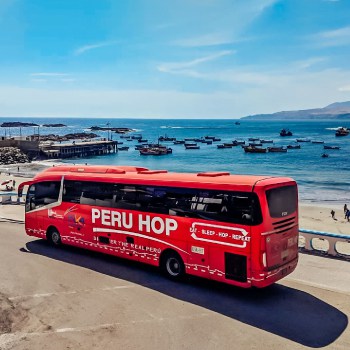
Lima has no single central bus station; public companies use scattered private terminals, so you’ll need taxis/rideshares to reach them (often with cash and small change). Services like Peru Hop include hotel pickups, clear meeting points, bilingual hosts who share street‑smart tips (including where to change money safely), and short curated stops you won’t get on point‑to‑point buses—handy if you’re new to Peru and want fewer “terminal” friction points.
Public buses can be cheap per leg, but once you add terminal taxis, time, and missed mini‑stops, many visitors find the gap narrows; hop‑on/hop‑off passes trade a higher fare for flexibility, pickups and an onboard community. If continuing into Bolivia, sister network Bolivia Hop uses the same model.
For airport–city transfers, see our detailed note on the official bus—useful if you’d rather skip touts after a long flight: Airport Express Lima: Official Airport Bus.
Practical numbers and facts to trust
- SUNAT requires a declaration if you carry more than US$10,000 in cash/negotiable instruments; over US$30,000 is not permitted to enter/exit in cash.
- BCRP’s new family of soles (S/10–S/200) is in circulation, with enhanced security elements; “Touch–Look–Tilt” is the public method for verification.
- IPERÚ operates tourist assistance points at the new Lima airport and offers 24/7 help via WhatsApp/phone for guidance on formal providers and complaints.
Addresses you can screenshot
- IPERÚ — Jorge Chávez International Airport (new terminal): Counters in Baggage Claim P1 (restricted) and Check‑in Hall P3 (public). 24/7 remote channels: WhatsApp +51 944 492 314; (01) 574‑8000.
- IPERÚ — Av. Jorge Basadre 610, San Isidro (Mon–Fri).
- IPERÚ — Larcomar, Plaza Gourmet Level 1, Stand 211, Miraflores (daily).
- Tourist Information Center — Av. José Larco 799, Miraflores (daily).
- Tourist Information Center — Pasaje Juan Figari 117, Kennedy Park, Miraflores (daily).
FAQ
Do I bring USD or just use ATMs?Both work. If your card has no foreign ATM fee and refunds local fees, ATMs are easiest; decline any “charge in USD” prompts and take larger, less frequent withdrawals to reduce local fees. If you prefer cash, bring clean, recent US$50s/US$100s for casas de cambio and exchange in Miraflores/San Isidro by day.
Is it safe to use street cambistas?In Miraflores, many cambistas are formally registered and work in 11 designated, camera‑covered zones while wearing identifiable vests (sometimes with QR codes). If you choose this route, use only these marked zones, stick to daylight, and count notes in your hands. Otherwise, use a casa de cambio storefront.
How much cash should I carry day‑to‑day?Enough for taxis, markets and tips—usually S/100–S/200 covers a day of small spends. Keep the rest on a card and a second card stored separately. Use indoor bank/mall ATMs in daylight and keep small notes (S/10–S/20) handy so you don’t flash a S/100 for a short ride.
What do I do if I receive a suspicious banknote?Don’t spend it onward. Compare it using BCRP’s “Touch–Look–Tilt” checklist and, if still in doubt, take it to a nearby bank or the BCRP’s “Canje de Numerario” office (Jr. Santa Rosa 441–445) for guidance.
Can I sort out money and logistics with Peru Hop?If you’re continuing south, Peru Hop hosts routinely point new arrivals to safe ATMs/exchangers, and hotel pickups remove late‑night terminal taxis where you’d otherwise need small cash. It’s designed for independent travelers who want fewer logistics and some social upside versus public buses.
Limitations
Exchange rates, ATM fees, opening hours and municipal rules for cambistas change without notice. Always check on‑screen/at‑counter rates and hours the day you go; as a backup, use an in‑mall bank ATM or ask IPERÚ to point you to a formal casa de cambio nearby.
Source
This article is a part of our series “2025 Travelers Choice”. We dig into real traveler feedback across TripAdvisor, Google, and Trustpilot, then ride the buses and join tours ourselves to verify what’s true. Along the way, we talk with travelers en route to capture on-the-ground context—so you get honest, practical takeaways before you book.