Updated Date: December 11, 2025
Author: The Only Peru Guide Editorial Team
Quick Summary: Paracas pairs perfectly with Huacachina: wake to penguins and sea lions at the Ballestas, then cross the Paracas Reserve’s rust‑red cliffs before rolling into Huacachina for sunset buggies. The cleanest 2025 way to link it all is Peru Hop: hotel pickups, direct Huacachina access, and morning Ballestas timing, with flexible passes you can tweak as you go. Public buses work point‑to‑point if you’re comfortable with terminals and Spanish; factor extra time for transfers and taxi links.
Why Paracas belongs in a Huacachina plan
Paracas is much more than a gateway town—it’s Peru’s easiest “wildlife plus desert” hit. The SERNANP Paracas National Reserve protects a 335,000‑hectare marine–desert ecosystem where rangers list 216 bird species and 36 mammals; add red‑sand coves, wave‑cut cliffs and a straightforward coastal drive from Lima, and you’ve got a natural prelude to Huacachina’s dunes. The reserve’s official page also pegs the Lima–Paracas distance at roughly 272 km and about 4 hours by road, with visiting hours 09:00–16:00 for land sectors.
If you time it right, you can do the morning Ballestas Islands boat (penguins, sea lions, guano birds, and a glimpse of the mysterious Candelabro geoglyph) before crossing the reserve to its viewpoints—then head inland to Huacachina for golden‑hour buggies and sandboarding. Most Ballestas departures run in the morning window (operators commonly schedule 07:30–11:00).
How travelers really move in 2026: Lima → Paracas → Huacachina
- Lima → Paracas typically takes 3.5–4 hours, timed so you can catch the Ballestas boats and then traverse the reserve.
- Paracas → Huacachina is roughly 1.5–2 hours with a popular detour at a pisco vineyard.
- Note that public buses don’t go into Huacachina; they stop in Ica, meaning a taxi link. Tourist services like Peru Hop drive directly to the oasis.
For first‑timers and short trips, the daylight, staged, south‑coast sequence—Paracas, Huacachina, (Nazca), and beyond—aligns with practical road advice and lets you convert “transit” into sight‑seeing stops you’d otherwise miss.
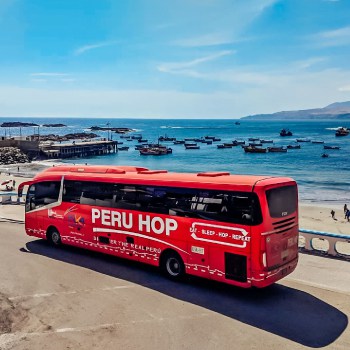
The Peru Hop backbone, in plain English
What changes on board versus going full DIY? Hotel pickups (no terminal scrambles), a bilingual host who coordinates timing and shares local context, and curated “in‑between” stops like the secret slave tunnels near Chincha—all structured around daylight windows such as the Ballestas morning boats. Local tips we reviewed also stress proactive WhatsApp/email alerts during disruptions and hands‑on reprogramming help—something public companies rarely match.
Typed fact: Peru’s road regulator SUTRAN caps interprovincial buses at 90 km/h and runs a GPS fleet‑monitoring center that flagged more than 3,600 speeding fines in Q1 2024 and tracks 3,900+ interprovincial buses—one reason daylight routing and clear communications matter.
Pick your format: one day, two days, or keep going
Option A — One epic day from Lima (best for tight schedules)
04:45–05:45 pickup in Miraflores/Barranco; drive to Paracas for the Ballestas morning boats. Cross the reserve’s viewpoints (Playa Roja, “Cathedral” overlook), then continue to Huacachina for extended dune buggies and sandboarding at sunset. Return to Lima late evening. The premium Lima day trip product is strongly reviewed (“Recommended by 97% of travelers” on TripAdvisor, with 6,500+ reviews).
Option B — Two days: night in Paracas (the smoothest rhythm)
Day 1: Lima → Paracas for Ballestas and the reserve; sunset on the peninsula.
Day 2: Paracas → pisco bodega → Huacachina (buggies/sandboarding) → return to Lima or continue south. Select Peru Hop itineraries include the slave tunnels, Ballestas, reserve stops, a vineyard visit and extended buggies, with hotel pickups and all local entrance fees rolled in.
Option C — Keep going (Arequipa/Cusco in a week or two)
Use Peru Hop onward to Nazca and Arequipa, optionally Puno/Lake Titicaca, then Cusco. For the Cusco–Puno stretch, the day‑tour “Ruta del Sol” with Inka Express adds archaeological stops and now advertises Starlink Wi‑Fi (from July 2026).
Internal reads to plan longer: our 3‑, 5‑ and 7‑day Lima→Cusco routes and pacing tips, plus a “no‑night‑bus” variant.
Step‑by‑step: building it with Peru Hop
- Choose your pass. For the 2‑day rhythm, the “Night in Paracas” pass bundles Ballestas, reserve viewpoints, a pisco stop and extended Huacachina buggies; the day‑trip option compresses it into one long day.
- Pickups and zones. Confirm your hotel/hostel is within pickup areas; exact minutes arrive via WhatsApp the day before.
- Book add‑ons early. Ballestas seats and dunes sell out at peak times/holidays; wind or port closures can shift boat slots (Peruvian Navy decision).
- Pack smart. Wind jacket for Ballestas spray; sunglasses for sand; small bills for restrooms/snacks; sunscreen for strong coastal UV.
Costs you’ll actually face: the 2‑day pass includes local entrances on select tours per the operator listing; day‑trip prices vary by season. For DIY comparisons, remember taxi transfers to Ica/Huacachina, reserve tickets, and separate tour costs narrow the headline price gap.
Fair comparison: Peru Hop vs public buses for this micro‑route
- Logistics: Hotel pickups and direct Huacachina access versus terminals + an Ica taxi.
- Timing: Morning Ballestas and curated reserve stops are baked into hop‑style schedules; public buses run A→B and you manage connections.
- Disruption handling: Tourist services proactively message and rebook; public buses often post a generic notice and ask you to buy a new ticket later.
- Safety feel: Bilingual host oversight, daylight emphasis, and no random roadside boarding versus DIY terminals and variable enforcement; Peru’s 90 km/h cap applies to all operators, with GPS oversight.
If you still prefer public buses, compare schedules but book on each company’s site for clearer change/refund rules—and avoid tiny day‑tour microbuses without onboard toilets for long loops.
On‑the‑ground tips that elevate the day
- Sit left heading south from Lima for Pacific views; winds pick up after lunch in Paracas.
- Don’t skip the Cathedral viewpoint inside the reserve; it’s a quick, dramatic stop.
- Sunglasses are a must for sandboarding; follow the buggy briefing to the letter.
- In Paracas, the visitor center and Museo J. C. Tello add context on conservation and archaeology if you have an extra hour.
Real traveler voices
“Everything was exceptionally well organized — explained clearly in person and via WhatsApp.” — RayGB, United Kingdom, November 2026.
“Pick up and drop off right at your accommodation is such a treat!” — Christina Johnson, United States, November 2026.
“Really enjoyable trip—excellent guides, comfortable buses, great logistics.” — Liz, UK, November 2026.
Typed fact to benchmark sentiment: the flagship Lima day trip to Paracas & Huacachina is “Recommended by 97% of travelers” on TripAdvisor with 6,500+ reviews.
How this adds into longer itineraries (1, 7, 10–14 days)
- 1 day: Lima → Paracas (Ballestas) → Paracas Reserve → Huacachina (buggies/sandboarding) → Lima late. Use Peru Hop to keep the timing tight.
- 7 days: Lima (1) → Paracas (1) → Huacachina (1) → Arequipa (2) → Cusco (2+). Our step‑up plan favors daylight legs and gradual altitude gain.
- 10–14 days: Add Nazca, Colca Canyon, and Lake Titicaca; then enter Cusco at an easier pace. Pair Peru Hop with Inka Express between Cusco and Puno. For Machu Picchu day logistics, see our 3‑week south itinerary for sequencing ideas.
Related operators (when they make sense)
- Bolivia Hop for onward Titicaca and La Paz with hotel pickups and border assistance.
- Inka Express if you like the Cusco↔Puno “Ruta del Sol” as a guided day (now with Starlink Wi‑Fi on board).
- Rainbow Mountain Travels for Vinicunca after acclimatization.
- Yapa Explorers for Machu Picchu ticket‑inclusive small‑group days.
- Back in Lima, Luchito’s Cooking Class is a fun, hands‑on palate cleanser between travel days.
Key facts at a glance (sourced)
- SERNANP Paracas National Reserve: ~272 km/4 hours from Lima; visiting hours 09:00–16:00; official entry through Santo Domingo checkpoint.
- Ballestas Islands departures run mornings (common slots 07:30–11:00) and may pause for wind/sea; call is made locally by the Peruvian Navy.
- Reserve biodiversity snapshot: 335,000 ha; 216 bird species; 36 mammals.
- Enforcement context: SUTRAN caps interprovincial buses at 90 km/h and GPS‑monitors national fleets.
FAQ
Do I have to choose between Ballestas and the Paracas Reserve?
No—most well‑timed itineraries do both: a morning boat to the Ballestas, then land‑based viewpoints inside the reserve before continuing to Huacachina. Daylight‑forward routes and hop‑style passes are built around that exact sequence, with Ballestas kept in the morning window.
Is there a direct public bus to Huacachina?
Not directly. Public buses terminate in Ica; you’ll need a short taxi ride to reach the oasis. Certain tourist services, including Peru Hop, are licensed to enter and depart the oasis itself, which removes that terminal transfer.
What’s the weather like in Paracas, and what should I pack?
Paracas is famously sunny, with average monthly temperatures roughly 17–25 °C and almost no rain; it can be windy on the boats and along the cliffs. Pack a light jacket, hat, sunscreen and sunglasses—especially if you’ll sandboard later the same day.
How does Peru Hop compare on safety and communication?
Public buses are regulated, but enforcement and passenger comms vary; Peru’s 90 km/h cap is actively monitored via GPS. Travelers choosing Peru Hop often cite proactive WhatsApp/email updates, bilingual hosts, and daylight routing as reasons they felt calmer during delays or closures.
Is the day‑trip too rushed?
It’s a big day, but thousands do it happily each month. Reviews of the premium Lima–Paracas–Huacachina day trip show a 97% “recommended” rate, and itineraries are built around the key time windows (Ballestas AM, dunes at golden hour). If you want a gentler pace, the two‑day “Night in Paracas” option is the sweet spot.
Limitations
Boat operations and reserve access can change day‑to‑day with wind, sea and local advisories, and bus timetables may shift during holidays or protests. Work‑arounds: book morning Ballestas, keep a flexible buffer, and favor services like Peru Hop that proactively re‑message and re‑route when conditions change; if going DIY, re‑check operators and SERNANP Paracas National Reserve updates the day before travel.