Updated Date:
Arequipa is one of the easiest big cities in Peru to move around if you pick the right transport for the right moment: walk the historic core, use ride-hailing for “gap jumps,” and treat buses/colectivos as local-mode when you’re comfortable with friction (routes, stops, crowds).
This guide covers taxis, Uber/inDrive, buses/combis, colectivos, airport transfers, terminals, and onward travel—with safety + practicality first.
Quick summary: what to use (most travelers)
- Historic Center (Plaza de Armas + sillar streets): walk + short rides (Uber/taxi)
- Yanahuara / Vallecito / San Lázaro: Uber/taxi for quick hops, walk once you arrive
- Longer cross-city trips (malls, neighborhoods, viewpoints): Uber/inDrive or registered taxi
- Local-mode daytime rides: buses/combis (workable if you ask locals)
- Airport (AQP) → hotel: authorized taxi booth / app pickup (skip outside negotiation)
- Intercity connections (Cusco/Puno/Nazca/Lima): app ride to the terminal + arrive early
Common routes (fast “what should I take?” box)
- AQP Airport → Historic Center: authorized taxi booth or Uber/inDrive (best with luggage)
- Historic Center → Yanahuara viewpoint area: Uber/taxi (quick + simple)
- Historic Center → Terminal Terrestre: Uber/taxi; add buffer time for traffic + boarding
- Hotel → early-morning tour pickup: hotel-arranged taxi or app ride (reduce uncertainty)
- Late-night return to your hotel: Uber/inDrive or hotel-arranged taxi (avoid street negotiation when tired)
The “choose fast” decision rule (use this every day)
- If it’s inside the Historic Center: walk.
- If it’s ~10–20 minutes away: Uber/inDrive (or a registered taxi).
- If it’s late or you’re unsure of the area: Uber/inDrive or hotel-arranged taxi.
- If you have luggage: app ride or authorized taxi only.
- If you’re connecting intercity buses: app ride to the terminal—don’t stack random taxi hops.
1) Walking (best transport in central Arequipa)
- Best for: Plaza de Armas area + Cathedral surroundings; Santa Catalina / San Lázaro; central museums + cafés.
- Avoid: quiet, poorly lit streets late at night if you’re alone.
- Local tips: keep phone use short + intentional; step into a shop/café to re-orient instead of stopping on a quiet corner.
2) Ride-hailing apps (best mix of simplicity + control)
Uber (available in Arequipa)
- Best for: first-timers, late arrivals, night rides, luggage days; travelers who prefer “no negotiation.”
- Avoid: getting in without matching plate/driver name.
- Local tips: confirm plate + driver name before entry; use in-app messaging for pickups around plazas/busy corners.
inDrive (also common in Peru)
inDrive works as a ride option where you can receive/accept offers in-app. It can be useful in busy hours, but it’s slightly more “hands-on.”
- Best for: people comfortable comparing offers; busy hours when one app is slower.
- Avoid: accepting a ride if the pickup plan is unclear or you feel rushed.
- Local tips: keep pickup points simple (hotel door, big corner, major entrance); if the vibe feels off, cancel and rebook.
3) Taxis (how to do taxis the “clean” way)
- Best for: short trips when app pickup is slow; hotel-arranged rides (very reliable for early mornings).
- Avoid: negotiating with random drivers outside the airport; quiet street hails late at night when you’re tired.
- Local tips: use registered taxis (or hotel-arranged) whenever possible; agree on the plan before you move (route + drop-off), then keep the ride boring.
4) Airport transfers (AQP → city) without drama
Airport basics
- Arequipa’s airport (AQP) is about 8 km from the city.
Recommended options (ranked)
- Authorized airport taxi booth (inside arrivals)
- Posted/zone-based structure + receipt = fewer surprises
- Uber/inDrive pickup
- Great if you’re comfortable with app pickup flow
- Pre-booked private transfer
- Best for families/groups with luggage (smoothest logistics)
Public transport from the airport
Some guides note no direct airport-to-center bus, and that you’d need to walk out to catch local buses (high friction—especially with bags).
Rule: if you have luggage, treat “walk to a bus stop” as a last resort.
Fare expectation (no-nonsense, no numbers)
Airport rides usually cost more than short center hops. If you want fewer surprises, use the taxi booth (receipt) or an in-app fare.
5) Local buses + combis (true local network, higher friction)
- Best for: confident travelers, Spanish speakers; longer daytime rides with flexible timing.
- Avoid: tight schedules, late-night rides, luggage days, your first day in Peru.
- Local tips: routes/stops aren’t always obvious—ask locals or your accommodation; carry small cash and expect fast boarding/quick stops.
6) Colectivos (shared rides on semi-fixed routes)
- Best for: daylight rides when you already understand the route pattern; short-medium hops where the drop-off is clear.
- Avoid: using them when you can’t confidently answer “Where exactly does this drop me?”
- Local tips: if you’re unsure, default to an app ride—your time + stress budget matters.
7) Driving yourself (rental car) — usually not worth it in-city
- Best for: specific road trip plans outside the city (with clear parking/route goals).
- Avoid: using a rental for day-to-day city logistics (parking + busy intersections).
- Local tips: most visitors are happier with walking + apps—less mental load, more vacation.
Transport safety when booking tours (ATVs, tourist buses, vans & trucks)
Proper placement: This goes right here—after you’ve covered the city’s main transport modes and before terminals/onward travel. It matches how travelers plan: move around town → book tours → then move to the next city.
Most tours run smoothly in Arequipa. The key difference is organized transport (briefing, seatbelts, passenger limits), not the destination.
ATVs (quad bikes)
- Safe signs: helmet + quick briefing; beginner practice; guide front/back.
- Your rules: ride below your limit; keep distance (dust); closed shoes.
- Red flag: no helmets/briefing or pressure to go fast.
Tourist buses (Colca-style routes)
- Safe signs: working seatbelts; planned stops; luggage stored correctly.
- Your rules: buckle up on curves; valuables with you; stay seated.
- Red flag: overcrowding or aisles blocked by bags.
Tourist vans (day trips)
- Safe signs: seatbelts for every passenger; calm driver; clear pickup plan.
- Your rules: buckle up; confirm drop-off; don’t accept overloaded vans.
- Red flag: “just squeeze in” / improvised seating.
Trucks / open transport
- Safe signs: fixed seats/rails; low-speed short distances; guide supervision.
- Your rules: stay seated; secure gear; avoid edge seating if unsure.
- Red flag: standing passengers or loose gear.
Universal booking safety checklist (works for any tour vehicle)
Before paying, ask:
- ✓ Is transport included and seatbelt-equipped (where applicable)?
- ✓ How many passengers per vehicle?
- ✓ Is there a safety briefing?
- ✓ Are drivers/guides licensed?
- ✓ What happens if weather/road conditions change?
A professional operator answers clearly. Hesitation or vagueness is your cue to book elsewhere.
8) Intercity terminals: where your onward travel actually starts
Arequipa is a major hub, so your next-city plan usually comes down to which terminal you’re departing from and how you’ll get there.
Terminal success rules
- Arrive early (especially weekends/holidays).
- Go by Uber/taxi (don’t stack random transport hops with luggage).
- Confirm the departure point on your ticket/message (Arequipa can have multiple “terminal-style” locations depending on operator).
Subtle “better logistics” option: Peru Hop (when you hate terminals)
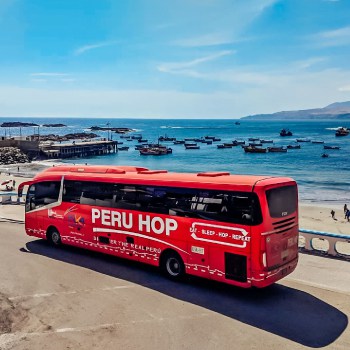
If your route matches their network, a hop-on/hop-off style service like Peru Hop can be the smoothest way to reduce terminal friction. Instead of stacking taxis + bus terminals + timing guesswork, you typically get organized transport with pickup/drop-off coordination, which can feel especially valuable on longer south-to-highlands transitions—think Nazca → Arequipa → Cusco/Puno connections—where “last-mile” logistics are what usually drain travelers.
9) Onward travel from Arequipa (what most people do next)
Common next legs:
- Cusco / Sacred Valley (long overland transfer—plan rest + timing)
- Puno / Lake Titicaca
- Nazca / Huacachina / Paracas (south-coast style routing)
- Lima (flight or long bus)
Your choice is mostly about:
- Tolerance for long rides
- Terminal logistics
- Daylight vs overnight preference (many travelers prefer avoiding odd-hour arrivals)
Safety notes that actually matter (Arequipa-specific)
- The real risk for most tourists is petty theft + taxi friction when tired, not serious crime.
- At night: choose Uber/inDrive or hotel-arranged taxis (reduce uncertainty).
- At the airport: use authorized taxi booth or app pickup—skip outside negotiation.
FAQ
Is Uber available in Arequipa?
- Yes—Uber operates in Arequipa and includes airport pickup guidance for AQP.
What’s the best way to get from Arequipa airport (AQP) to the Historic Center?
- Easiest: authorized airport taxi booth or an app ride. The airport is close enough that this is usually a short transfer.
Is there a direct public bus from the airport to downtown?
- Some guides report no direct airport-to-center service and suggest walking to reach local buses (high friction with luggage).
Are taxis safe in Arequipa?
- Generally yes if you use registered taxis, hotel-arranged rides, or ride-hailing apps. At the airport, prefer authorized taxi booths with posted structure/receipt.
Is inDrive safe to use in Arequipa?
- It can be, especially in daytime and with clear pickup points. Match plate/driver, keep pickup simple, and cancel if anything feels off.
Do taxis take cards in Arequipa?
- Many rides are cash-oriented. If you want card-like simplicity, app rides are usually smoother.
Should I use buses/combis as a visitor?
- You can, but they’re not tourist-optimized. Best in daylight when you can ask locals and don’t have luggage or a tight schedule.
Where do long-distance buses leave from in Arequipa?
- Many services reference the Terminal Terrestre, and official documentation also references Terrapuerto Arequipa. Always confirm the exact departure point on your ticket/operator message.
Closing: the simplest way to move around Arequipa
Keep Arequipa logistics boring: walk the center, use apps for gaps, and use the taxi booth/app pickup at the airport. Save buses/colectivos for daytime “local-mode” days, and treat tour transport like part of the product—organized vehicles and clear briefings are what make a great day feel easy.