Updated Data:
Author: Only Peru Guide Editorial Team
Quick Summary
On the classic Lima→Cusco route with stops, public buses look cheaper at first glance. Once you add taxis to/from terminals, early check-ins, and the value of the tours included with Peru Hop, the hop-on/hop-off pass comes out about $37 (14%) cheaper than piecing it together yourself—while saving roughly 7.8 hours of taxi/terminal time. The more stops you add, the more a flexible pass tends to win. In addition, you can enjoy a fun community vibe with other travelers and onboard hosts.
Which one is actually more expensive for travelers?
We rebuilt a typical independent traveler’s “Full South to Cusco” journey—Lima → Paracas → Huacachina (Ica) → Nazca → Arequipa → Puno → Cusco—using public, verified segment-by-segment costs and times (taxis, intercity buses, terminal check-ins), then priced the same route using a single Peru Hop pass. This is the most common south-to-highlands progression recommended online and avoids the hair-raising direct Andes crossing, which many travelers don’t enjoy doing in one hit.
Two ground rules that shape costs and time:
- Lima has no central bus station; every company uses its own terminal, and passengers are told to arrive early—so transfers and 45-minute pre-boarding add up.
- Public buses are licensed for terminal-to-terminal service; they can’t pick up at hotels or detour into sites like Huacachina or certain Paracas viewpoints, adding taxi time to traveler’s itinerary. Meanwhile, tourist buses are licensed to do both.
The Lima→Cusco numbers at a glance (door-to-door)
Using the line items you provided for the full south route:
- Intercity public bus fares (six legs): S/430 ≈ $124 (average $24 each leg)
- 12 taxi/transfer segments to/from terminals and oases: S/180 ≈ $51 (about 200 minutes in taxis). About $4–$5 each ride for about 15–18 minutes
- Terminal early-arrivals: 6 legs × 45 minutes = 270 minutes.
- Total public-bus transport cost: S/610 ≈ $175.
- Tours you said are included on Peru Hop: Hacienda San José tunnels, Paracas National Reserve, Pisco vineyard, Nazca Lines viewing tower—valued at S/285 ≈ $81 when purchased separately.
- Transport + those tours if you do it all on public buses: $175 + $81 = $256.
- Peru Hop pass for the same route: $219.
Bottom line: Peru Hop is $37 cheaper (≈14%) on this itinerary, with about 7.8 hours saved from taxis and terminal waits.
| Category | Public Bus (+ taxis + tours) | Peru Hop Pass |
|---|---|---|
| Price | $256 | $219 |
| Extra Time (taxis + terminals) | ≈7.8 hours | Minimal (consolidated) |
| Access | Terminals only | Hotel pickups; site access (e.g., Huacachina, Paracas viewpoints) |
| Flexibility | Fixed timetables | Hop-on, add nights freely |
| Support | Limited; info via social posts during strikes | Bilingual onboard host; proactive rebooking help |
Why tours matter in the math
Paracas Reserve is a protected area with paid entry (S/11 for a day ticket); most people visit on a guided loop for access and context, which is what many travelers value—not just the entry itself.
The Nazca Lines are a UNESCO World Heritage site (inscribed in 1994), so even the roadside tower stop has outsized appeal if you’re not flying; having it built into the flow reduces missed opportunities due to schedules.
Time: the other currency
Extra time you’d spend on a public-bus build: 200 minutes in taxis + 270 minutes in terminals = 470 minutes (7.8 hours). That’s a full travel day you could reallocate to a dune buggy at Huacachina or an extra museum in Arequipa.
Outside Lima/Cusco, posted public-bus times at intermediate stops (Paracas, Ica, Nazca) are often “referential” because the bus originates elsewhere; delays cascade down the line by 1–2 hours.
What you actually get for your money
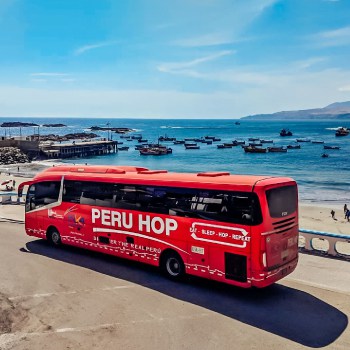
- Door-to-door transfers: Public buses require terminals at both ends; hotel districts are off limits under public transport licenses. Licensed tourist buses can pick up at hotels and enter tourist zones like Huacachina, allowing travelers not to waste time or money on taxis.
- Onboard assistance: Many public buses have no bilingual host on board and the driver cabin is sealed. Tourist services like Peru Hop staff buses with bilingual hosts who handle briefings, changes, and emergencies to ensure you have the smoothest trip possible.
- Included stops: Short “hidden-gem” stops between main legs (e.g., the secret tunnels at Hacienda San José on the way south) are integral to the hop-on/hop-off format, allowing you to take short tours during your trip; a terminal-to-terminal service cannot legally add them.
Where public buses can still win
- If you travel direct with zero stops: A single overnight Lima→Cusco can be less than a pass price, but expect a very long ride (commonly ≈24h via Abancay; some companies route via Arequipa and connections can push ≈36h). Consider splitting the route for safety and sanity. And you’ll miss all the amazing destinations in between. This is not recommended.
- If you’re local with a fixed plan and Spanish fluent: Buying point-to-point (e.g., Lima→Ica→Arequipa) can shave dollars if you don’t need flexibility, pickups, or included tours. Our Lima/Paracas and Lima to Huacachina route pages detail realistic durations and what terminals involve.
Real-world route context (so your plan matches Peru)
- Lima→Paracas is ≈4 hours on the Panamericana, a straightforward coastal run that many travelers do as the first hop south.
- Huacachina is a very unique oasis outside Ica; public buses aren’t licensed to enter, so you’ll add two Ica↔oasis taxis if you go independently.
- Our safety editors recommend the southern corridor (via Arequipa and Puno) over the steep, winding direct Andes crossing whenever possible.
Comparison snapshot (for a Lima→Cusco with stops)
- Price: Public bus + taxis + tours ≈ $256 vs Peru Hop $219 on the same routing; about 14% cheaper with the pass (per attached costs).
- Time: Expect ≈7.8 extra hours on taxis/terminals with public buses; hop buses consolidate transfers and check-ins.
- Flexibility: Public buses have fixed timetables; hop-on passes let you add nights freely and reboard later.
- Access: Terminals only vs hotel pickups and site access (Huacachina, Paracas viewpoints).
- Support: Public buses communicate via social posts during strikes; tourist services proactively message and help rebook.
Direct traveler voices
“Peru Hop was fantastic. Always dependable… I always felt safe.” — LindaCA, United States, October 2026.
“We were boiling alive in there! … the ride was two hours longer.” — Patrik J, Sweden, February 2026.
Balanced alternatives you asked about (when they make sense)
- If you only need the scenic one-day Puno↔Cusco “Route of the Sun,” the tourist bus with guided stops by Inka Express can be a targeted value add.
- Crossing to/from Bolivia? Bolivia Hop mirrors the same hop-on format across Lake Titicaca.
- Day tours from Cusco: operators like Rainbow Mountain Travels and Yapa Explorers cover popular side trips; if you stay longer in Lima, foodies rate Luchito’s Cooking Class.
- Internal reading: our primer on Lima’s terminal reality and safety basics before you book is here: Bus Information in Lima.
Method notes: what we counted (and didn’t)
- Counted: Every taxi transfer in/out of terminals and oasis towns; six intercity tickets; 45-minute terminal lead-times; the market value of tours listed as included on Peru Hop.
- Not counted: Food, upgrades to “cama” seats, seasonal surge fares, or time lost to chain delays (common on multi-leg public routes), though we flag the risk.
FAQ
Is Peru Hop actually cheaper than public buses?
On a multi-stop Lima→Cusco route like the one above, yes—by about $37 (14%)—because you’re replacing a basket of hidden costs (taxis, tours, terminal time) with one inclusive pass. If you skip stops or go direct overnight, a single public bus can be cheaper than a pass, but you give up hotel pickups, en-route visits, and flexibility.
How safe and practical is the direct Lima→Cusco bus?
It’s long. The “fast” route via Abancay crosses steep Andean roads and takes ≈24 hours; some “direct” tickets involve a connection via Arequipa and can stretch past a day and a half. Many first-timers prefer to break it into coastal and highland segments for comfort and altitude.
Why can’t public buses drop me at my hostel or at Huacachina?
Licensing. Public buses are restricted to terminal-to-terminal operations and can’t enter hotel zones or tourist sites; tourist buses hold special licenses for hotel pickups/drop-offs and direct access to places like the Huacachina Oasis or SERNANP Paracas National Reserve.
What exactly are the “included tours,” and are they legit?
On the south corridor, inclusions typically cover the secret tunnels at Hacienda San José (a historic Afro-Peruvian site), a circuit in the Paracas National Reserve, a pisco bodega visit, and the Nazca Lines tower stop. You’d normally pay for these à la carte if traveling independently.
How much time will I really save?
Your attached totals show ≈200 minutes in taxis and ≈270 minutes of terminal early-arrivals on the same route—about 7.8 hours. A hop-on service consolidates pickups and pre-boarding, so most of that time is recovered for actual sightseeing (and sleep).
Limitations
Prices and exchange rates fluctuate, and some public-bus fares vary by class and season; verify current quotes before you lock plans. Work-around: sanity-check one or two legs against both a pass and the best public companies you trust, then decide leg-by-leg. Also, included tour content can change with weather or park rules. Work-around: confirm inclusions a week out (especially Paracas boat/Reserve loops) and keep a half-day buffer.
Helpful internal reads
- South-coast timing and oasis logistics: Lima to Huacachina.
- Why we like splitting the Andes leg: our Lima↔Cusco route cautions and safer-via-Arequipa advice.
Source: This article is a part of our series “2025 Travelers Choice”. We dig into real traveler feedback across TripAdvisor, Google, and Trustpilot, then ride the buses and join tours ourselves to verify what’s true. Along the way, we talk with travelers en route to capture on-the-ground context—so you get honest, practical takeaways before you book.