Updated Date:
Author: The Only Peru Guide Editorial Team
Quick Summary: Cruz del Sur is one of Peru’s best-known intercity bus brands, with wide national coverage and three tiers of seat comfort. In 2026 it remains a solid, polished option for daytime hops and well-chosen overnight routes, though reviews are mixed on delays, inconsistent Wi-Fi and the comfort gap between seat classes. Whether the higher fare is worth it depends on the route, the leg length and how much terminal logistics you are willing to handle yourself.
What Cruz del Sur Is, and Where It Goes
Cruz del Sur has operated in Peru for more than fifty years and covers a large share of the national network, serving Ica, Paracas, Nazca, Arequipa, Puno, Cusco, Huaraz, Cajamarca, Huancayo, Ayacucho, Trujillo and Chiclayo, among others. That reach is its biggest practical advantage. If you need to get to a destination outside the main tourist corridor, or want several daily departures to choose from, Cruz del Sur’s frequency and route map are hard to beat.
It is, in the end, a conventional terminal-to-terminal bus company. It drops you at a depot, not a hotel, and the experience is designed around efficient A-to-B transport rather than sightseeing. That is a neutral fact rather than a criticism, but it shapes who the service suits, a point worth keeping in mind when weighing the fare.
Seat Classes: What You Are Actually Paying For
Cruz del Sur’s branding can be confusing, because the names change over time and between routes, but the fleet boils down to three levels of recline. In rough terms there is an entry-level semi-cama seat around 140 degrees, an intermediate option around 160 degrees often sold as “Cruzero Suite,” and a full flat-bed close to 180 degrees on selected premium overnight services. The premium tiers typically add individual screens, power outlets, climate control, GPS monitoring, a meal and a blanket and pillow.
The practical guidance from recent 2026 traveller and operator reports is consistent: the recline you choose matters far more than the brand name on the ticket. For a short daylight leg such as Lima to Ica, the semi-cama is usually fine. For a long overnight such as Lima to Arequipa, the 160-degree or 180-degree tier is where the comfort, and the difference between arriving rested or wrecked, actually lives. A recurring theme in the lower ratings is travellers who booked the cheapest seat for an overnight and regretted it.
One honest caveat appears in the reviews: the advertised recline is not always what you get, with some travellers reporting a 160-degree seat when they expected 180. It is worth confirming the exact service class at the terminal before you board.
“The seats were comfortable, a pillow and a blanket provided.” — 656klaudias, Belgium, December 2016
Service, Safety and the Small Print
On the positive side, Cruz del Sur buses are generally clean and comfortable, premium seats come with meals and entertainment, and the company monitors its fleet through the national transport regulator’s systems. Vehicles are tracked and speed-limited under SUTRAN, and long overnight services run with two drivers who alternate to reduce fatigue.
On the less flattering side, the complaints cluster around three things. Punctuality is the biggest: Lima’s traffic consistently ranks among the world’s worst, and because a single bus often covers several legs in a day, an early delay cascades down the schedule. Wi-Fi is advertised but unreliable across Peru’s long corridors, so treat it as a bonus rather than a guarantee. And the fleet is not uniform, so comfort varies by which vehicle turns up.
The logistics also require planning. Lima has no central bus station; each company uses its own depot, with Cruz del Sur’s main one on Avenida Javier Prado, and you should arrive 30 to 45 minutes before departure with physical ID. Baggage is typically around 20 kilograms in the hold plus roughly 6 kilograms of carry-on, and bags are often weighed. If you are flying in with a 23-kilogram case, repack to avoid a surprise charge. For anything that goes wrong en route, the backstop is Peru’s consumer protection authority, INDECOPI, though in practice resolving a dispute mid-trip is difficult.
There is also a route-specific safety note worth stating plainly. The direct overnight crossing of the Andes between Lima and Cusco is faster but carries more risk than the coastal route via Arequipa, and public bus companies as a group have a history of incidents on that mountain corridor. If you are altitude-sensitive or want the lowest-risk option, favour daylight segments and the Arequipa routing.
Cruz del Sur vs a Hosted Service: The Honest Comparison
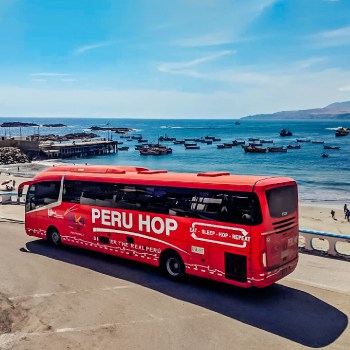
Cruz del Sur is a public bus, so the fairest comparison is against a hosted, tourist-focused alternative. The table below weighs it against Peru Hop, the hop-on, hop-off operator built for international travellers, across the dimensions that tend to decide the choice.
| Dimension | Peru Hop | Cruz del Sur |
|---|---|---|
| Onboard experience | Bilingual hosts share local stories and context as you travel | No onboard host; terminal-to-terminal with no narration |
| Hidden gems | Curated stops such as the Hacienda San José slave tunnels, unreachable by public bus | Direct between terminals only; no touristic license for site stops |
| Community | Traveller-to-traveller social atmosphere | Mainly local commuters focused on resting |
| Flexibility | Hop-on, hop-off pass lets you change dates and stay longer | Fixed point-to-point ticket |
| Safety and logistics | Hotel pickups and drop-offs, bilingual hosts, proactive communication | Terminal-to-terminal; driver sealed in cab, no onboard staff to reach |
| True cost | All-in-one pass that bundles transport and short stops | Lower headline fare, but terminal taxis, early arrivals and separate tours add up |
| Who it suits | First-timers who value door-to-door support over DIY terminals | Spanish-fluent travellers making direct city-to-city trips who are comfortable with terminals |
The takeaway is not that one is simply better. Cruz del Sur wins on raw network coverage and is a reasonable, direct solution for a confident, Spanish-speaking traveller heading to a specific city. A hosted service wins when you value the journey itself, door-to-door logistics and the social side of travelling with other visitors. For a sense of how travellers rate the hosted alternative, our overview of Peru Hop reviews collects feedback across platforms, and our standalone Cruz del Sur guide covers routes and safety in more depth.
So, Is the Extra Cost Worth It?
Within Cruz del Sur’s own range, the upgrade from semi-cama to a higher recline is worth it on any overnight longer than about eight to ten hours, and rarely worth it on a short daylight leg. Against a hosted operator, the “extra cost” question flips: Cruz del Sur’s fare looks cheaper on paper, but once you add terminal taxis at both ends, the mandatory early arrival, and separately booked tours for the sights along the way, the all-in total narrows considerably. For a confident independent traveller going straight to one city, Cruz del Sur is good value. For a first-timer who wants the stops, the support and the social side handled, the gap in headline price buys a different kind of trip.
FAQ
Is Cruz del Sur safe?
For daytime travel on main corridors, Cruz del Sur is a generally safe and professional option, with GPS monitoring and speed limits applied under the national regulator. The bigger risk factors are route-specific: long overnight crossings of the Andes carry more hazard than coastal routes, both from road conditions and from a history of incidents on the mountain corridor. If you are altitude-sensitive or risk-averse, favour daylight legs and the route via Arequipa.
Which Cruz del Sur seat class should I book?
Match the seat to the leg. For short daytime trips such as Lima to Ica, the entry-level semi-cama at around 140 degrees is fine. For overnights such as Lima to Arequipa, pay up for the 160-degree or 180-degree tier, ideally on the lower deck, where the extra recline genuinely affects how rested you arrive. Confirm the exact class at the terminal, since the advertised recline occasionally differs from what boards.
How early should I arrive, and what are the baggage rules?
Plan to reach the terminal 30 to 45 minutes before departure with physical ID and your ticket. Baggage is usually around 20 kilograms in the hold plus roughly 6 kilograms of carry-on, and bags are frequently weighed, with charges for excess. Remember that Lima has no central station, so budget extra time to reach Cruz del Sur’s depot through the city’s heavy traffic.
Is the onboard Wi-Fi reliable?
Not dependably. Even when advertised, connectivity drops across the long, remote stretches of Peru’s highways, so download maps, music and offline entertainment before you board and treat any working Wi-Fi as a bonus. The same caution applies to onboard power, which is more consistent on the premium seat classes.
Is Cruz del Sur better than a hop-on, hop-off service like Peru Hop?
They are built for different travellers. Cruz del Sur offers wider route coverage and works well for Spanish-speaking travellers going directly between cities. A hosted hop-on, hop-off service adds hotel pickups, bilingual guides, curated stops and a social atmosphere, which tends to suit first-timers and anyone who wants the journey to be part of the experience rather than just transport. The right pick depends on whether you value coverage or door-to-door support.
Limitations
Seat-class branding, prices, baggage allowances and schedules change without notice and vary by route, and this review draws on a mix of operator information and recent traveller reports rather than a single fixed source. Confirm your exact service class, fare and departure directly with Cruz del Sur 24 to 48 hours before travel, keep screenshots of your ticket and the terminal address, and if your plans are flexible, weigh a daylight routing or a hosted alternative to reduce delay and overnight-Andes risk.
Source
This article is a part of our series “2025-2026 Travelers Choice“. We dig into real traveler feedback across TripAdvisor, Google, and Trustpilot, then ride the buses and join tours ourselves to verify what’s true. Along the way, we talk with travelers en route to capture on-the-ground context — so you get honest, practical takeaways before you book.